★ Forthcoming Publication
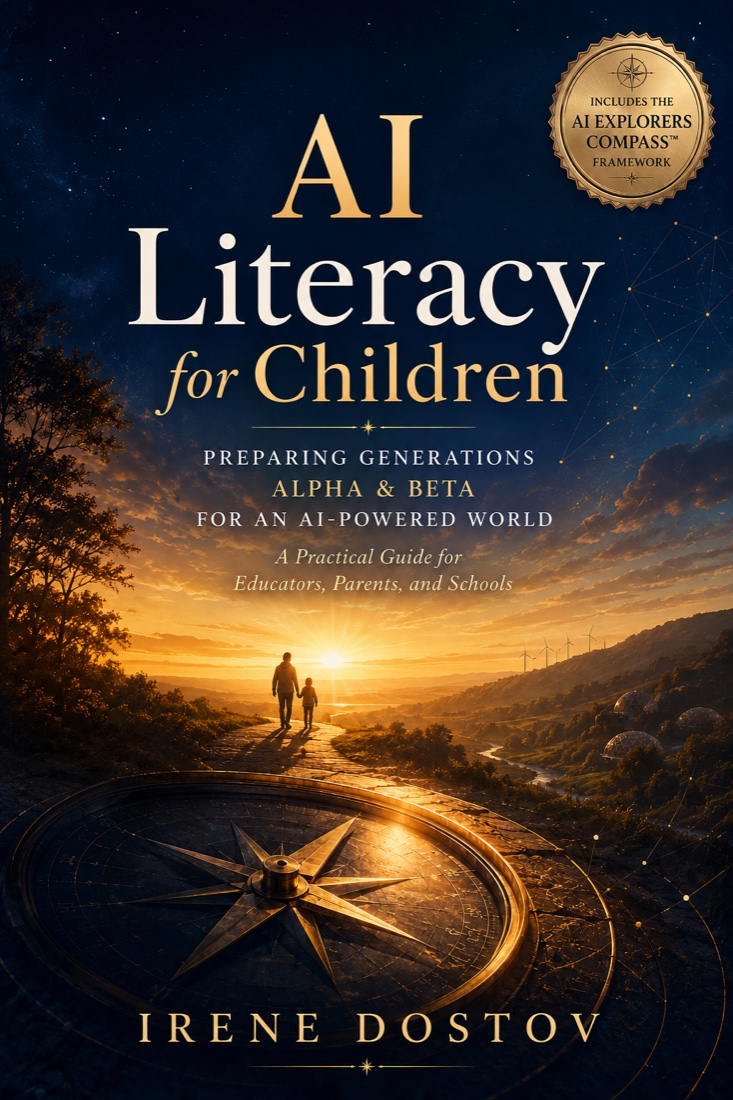
AI Literacy for Children
Preparing Generations Alpha & Beta for a World with Artificial Intelligence.
Digital PDF edition + limited U.S. print batches
Preparing Generations Alpha & Beta for a World with Artificial Intelligence.
Digital PDF edition + limited U.S. print batches
Artificial Intelligence is already part of childhood. The question is no longer whether children will encounter AI — but whether they will understand how to think, create, and make responsible decisions alongside it.
Parents are asking what children should know. Teachers are being asked to introduce AI without clear guidance. School leaders are making decisions about technology faster than educational frameworks can keep up.
AI Literacy for Children was written for that gap.
Rather than chasing rapidly changing AI tools, this book offers a practical, age-aware way to understand what AI Literacy means for children — from early childhood through the school years.
It will help you ask better questions, make more informed decisions, and begin building an approach to AI that protects what matters most: children's thinking, creativity, judgment, and humanity.
The goal is not to make every child an AI engineer.The goal is to help children become informed, confident, and responsible participants in an AI-powered world.
Most books about AI begin with tools.
This book begins with the child.
It explores how Artificial Intelligence is reshaping learning, creativity, information, decision-making, and childhood itself — and what adults responsible for children need to understand now.
Instead of chasing the latest software, AI Literacy for Children focuses on the human capacities children will need regardless of how technology changes.
Because the tools will change. Childhood should not be left to catch up.
A proprietary AI Literacy framework developed to help children navigate a world shaped by Artificial Intelligence — without losing the human capacities that matter most.
Rather than teaching children to follow a specific tool or platform, the Compass offers a timeless way to think about AI Literacy across childhood.
The full framework is introduced inside the book.
"Preparing children for an AI-powered world isn't about teaching them to compete against Artificial Intelligence. It's about teaching them to think with AI — while remaining deeply human."— Irene Dostov (Miss JOY)
No. The book is written for educators, parents, and school leaders without requiring any technical background.
No. Its focus is AI Literacy — timeless principles for thinking, creating, and making responsible decisions with AI — rather than programming or any specific platform or tool.
Yes. Teachers will find practical classroom strategies and implementation ideas throughout the book.
Absolutely. The book was intentionally written in clear, accessible language for families.
The primary focus is children from early childhood through primary education, with principles that can be adapted beyond those years.